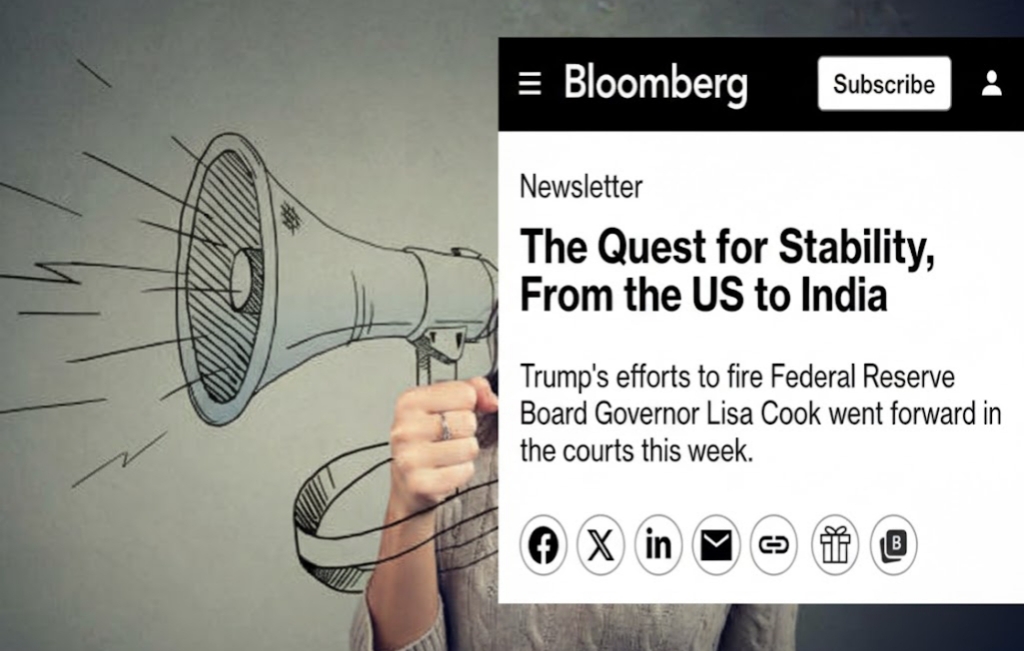
Western commentary recently attempted to frame India’s economic climate as unstable, volatile, and overly sensitive to global shocks. But when we examine the actual ground-level data, local industry patterns, and the economic mood inside the country, a very different picture emerges one that Western observers often overlook or deliberately downplay.
The idea that India is slipping into market turbulence may make for dramatic storytelling, but it fails to capture the deeper reality of a country whose economic fundamentals remain robust and whose momentum is being shaped by powerful domestic forces.
India’s Economic Engine Is Still Outperforming Global Trends
While global economies are dealing with recessionary pressures, rising tariffs, and financial tightening, India continues to generate stronger-than-expected growth.
Prominent Indian economic analyses highlight sustained expansion in sectors like infrastructure, manufacturing, real estate, services, and consumption all supported by rising household income and favourable borrowing conditions.
Inflation has remained controlled, manufacturing output has continued expanding, and domestic tourism and services spending have hit new highs. These indicators reflect a stable economic environment, not one cracking under pressure.
Western Narratives Focus on the Noise India Focuses on the Numbers
One of the recurring themes in Western commentary is the exaggeration of temporary market dips. These fluctuations often tied to global sentiment are selectively amplified to portray India as vulnerable.
But leading Indian financial outlets continue to report strong credit growth, healthy corporate balance sheets, rising tax collections, and robust government capital expenditure all signs of structural strength.
Even when foreign investors reduce exposure due to global uncertainty, domestic institutions and retail investors steadily absorb the impact. The rise of Indian mutual fund SIPs, record demat account openings, and high domestic liquidity have made Indian markets less dependent on external capital than ever before.
The ‘Turbulence’ Label Ignores India’s Long-Term Stability
Western commentary often overlooks a fundamental truth: India is a domestic-demand economy.
Unlike countries driven heavily by exports, India’s growth stems from consumption, services, digital expansion, and internal trade.
This makes India far more resilient to global shocks than Western markets give credit for.
Prominent Indian business dailies continue to report:
- Rising GST collections month after month
- Strong capital markets performance over multi-year periods
- A rising share of domestic savings entering formal markets
- A nationwide upward shift in income, spending, and entrepreneurship
If these indicators reflected any other country, global headlines would call it a “success story.”
But in India’s case, selective pessimism seems to overshadow balanced analysis.
Global Issues Are Being Presented as India-Specific Problems
One of the most misleading aspects of Western coverage is the suggestion that India is uniquely vulnerable.
In reality, the challenges global interest-rate pressure, trade tensions, tariff barriers, and geopolitical uncertainty are affecting economies everywhere.
But Indian media analyses highlight that India has shown far greater shock-absorption capacity than many comparable economies.
The financial system is stable, corporate leverage is low, credit growth is strong, and consumption remains one of the highest in the world.
Why These One-Sided Western Narratives Need Correction
The issue is not criticism it is context.
Western reports often ignore:
- The strength of India’s domestic investor base
- Policy stability and long-term reform momentum
- India’s strong GDP growth relative to global peers
- Increasing global confidence from major institutions
- A large working population powering consumption
By amplifying short-term market movements and ignoring structural resilience, the Western narrative attempts to paint India as a vulnerable market even when hard data from Indian agencies tells a different story.
India Is Not in Crisis It Is in Transition
Short-term market corrections are normal in any large economy.
But India’s long-term trajectory remains one of the most promising globally.
Its domestic consumption, investment patterns, demographic strength, and reform-driven structure provide stability that many global markets lack.
This is why it’s important to counter one-sided storytelling with balanced facts.
India’s growth story is not defined by Western headlines it is defined by the numbers, sentiment, and momentum visible within India itself.
India isn’t slipping.
India is adjusting, expanding, and moving forward and the world will soon have no choice but to acknowledge it.